


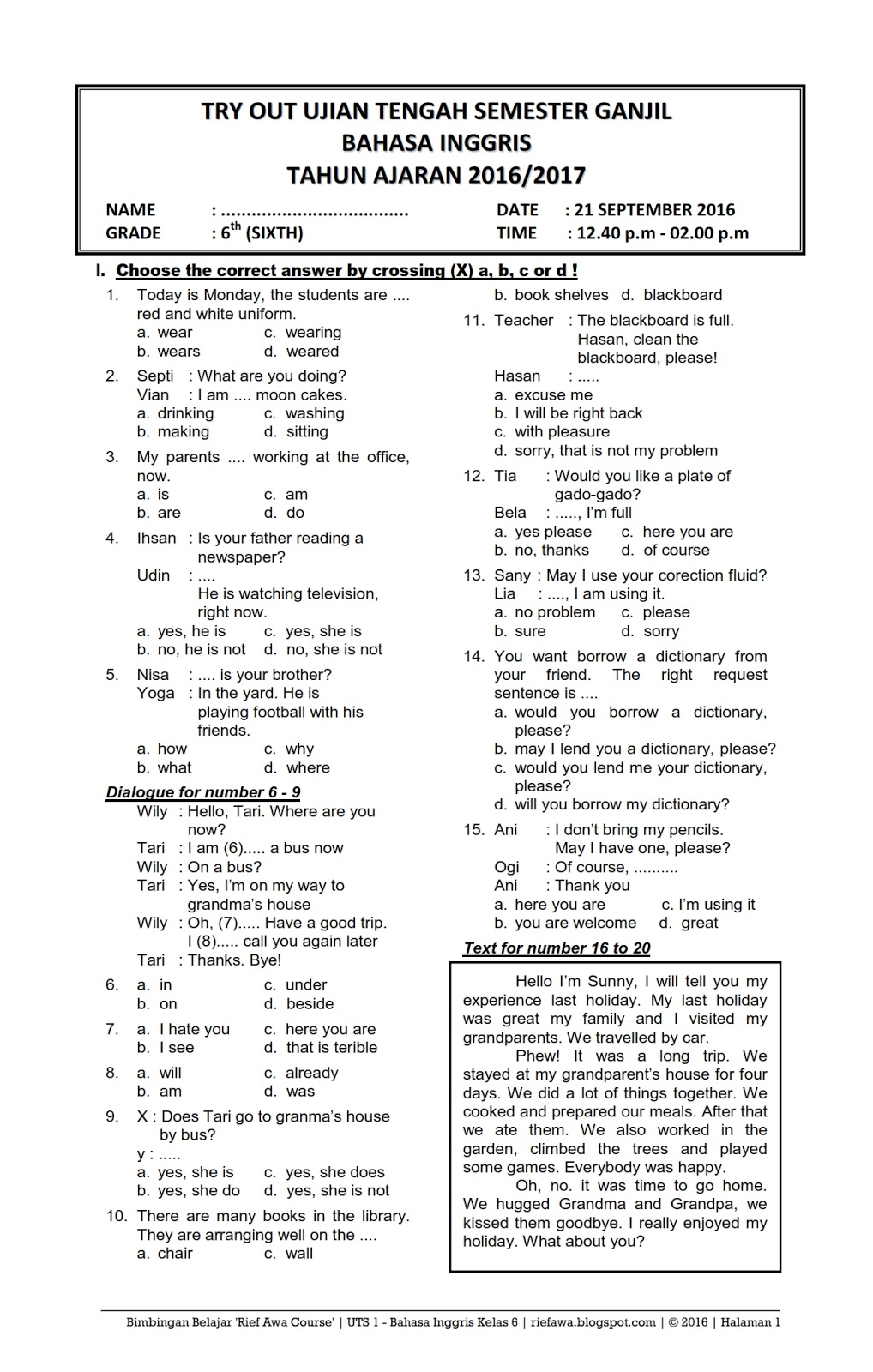
Ujian Tengah Semester (UTS) merupakan salah satu tolok ukur penting dalam proses pembelajaran siswa. Bagi siswa kelas 6 Sekolah Dasar, UTS Bahasa Inggris semester 2 memegang peranan krusial untuk mengukur sejauh mana pemahaman mereka terhadap materi yang telah diajarkan selama paruh pertama semester. Mempersiapkan diri dengan baik tidak hanya mengurangi kecemasan, tetapi juga meningkatkan kepercayaan diri dan performa saat ujian. Artikel ini akan membahas secara mendalam mengenai persiapan UTS Bahasa Inggris kelas 6 semester 2, dilengkapi dengan contoh-contoh soal yang relevan dan penjelasan strategi menjawabnya.
Pentingnya UTS Bahasa Inggris di Kelas 6
Pada jenjang kelas 6, pembelajaran Bahasa Inggris biasanya semakin terstruktur dan mendalam. Siswa diharapkan mampu memahami dan menggunakan kosakata serta tata bahasa yang lebih kompleks. Keterampilan membaca, menulis, mendengarkan, dan berbicara (four skills) mulai diasah lebih intensif. UTS semester 2 menjadi momen evaluasi komprehensif untuk memastikan bahwa siswa telah mencapai target pembelajaran yang ditetapkan, serta untuk mengidentifikasi area mana yang masih memerlukan perbaikan sebelum memasuki jenjang SMP.
Materi yang Umumnya Diujikan pada UTS Bahasa Inggris Kelas 6 Semester 2
Meskipun kurikulum dapat bervariasi antar sekolah, beberapa topik umum yang seringkali menjadi fokus pada UTS Bahasa Inggris kelas 6 semester 2 meliputi:
- Kosakata (Vocabulary): Topik yang lebih luas dan mendalam seperti profesi, hobi, kegiatan sehari-hari, makanan dan minuman, tempat umum (sekolah, pasar, rumah sakit), deskripsi orang dan benda, serta kata sifat (adjectives) untuk mendeskripsikan.
- Tata Bahasa (Grammar):
- Present Tense (Simple & Continuous): Penggunaan present tense untuk menyatakan kebiasaan, fakta umum, dan kejadian yang sedang berlangsung.
- Past Tense (Simple): Penggunaan simple past tense untuk menyatakan kejadian yang sudah terjadi di masa lalu, termasuk kata kerja beraturan (regular verbs) dan tidak beraturan (irregular verbs).
- Future Tense (will/going to): Penggunaan "will" dan "going to" untuk menyatakan rencana atau prediksi di masa depan.
- Articles (a, an, the): Penggunaan artikel yang tepat.
- Prepositions of Place and Time (in, on, at, under, beside, before, after): Penggunaan preposisi yang tepat.
- Pronouns (personal, possessive, demonstrative): Penggunaan kata ganti yang benar.
- Question Words (What, Where, When, Who, Why, How): Pembentukan kalimat tanya yang benar.
- Adjectives and Adverbs: Penggunaan kata sifat dan kata keterangan.
- Membaca (Reading Comprehension): Memahami teks pendek seperti cerita, deskripsi, instruksi, dan pengumuman.
- Menulis (Writing): Menulis kalimat sederhana, paragraf pendek, atau merespon pertanyaan.
- Mendengarkan (Listening Comprehension): Memahami percakapan pendek, instruksi, atau deskripsi yang diperdengarkan.
- Berbicara (Speaking – meskipun jarang diujikan secara tertulis di UTS, pemahaman materi ini penting untuk menjawab soal listening/reading): Kemampuan mengungkapkan ide sederhana.
Strategi Efektif untuk Menghadapi UTS Bahasa Inggris
- Pahami Materi Ulang: Tinjau kembali buku catatan, buku teks, dan materi ajar yang diberikan oleh guru. Fokus pada topik-topik yang telah disebutkan di atas.
- Perkaya Kosakata: Buat daftar kata-kata baru beserta artinya dan coba gunakan dalam kalimat. Gunakan flashcards atau aplikasi belajar kosakata untuk membantu.
- Latihan Tata Bahasa: Kerjakan latihan soal-soal tata bahasa secara rutin. Pahami perbedaan penggunaan tenses, preposisi, dan kata ganti.
- Perbanyak Latihan Membaca: Bacalah teks-teks berbahasa Inggris yang sesuai dengan tingkat kelas 6. Latih kemampuan menjawab pertanyaan berdasarkan isi teks.
- Simulasi Soal: Lakukan simulasi dengan mengerjakan contoh-contoh soal UTS. Ini akan membantu Anda terbiasa dengan format soal dan manajemen waktu.
- Manajemen Waktu: Saat mengerjakan soal, alokasikan waktu untuk setiap bagian. Jangan terlalu lama terpaku pada satu soal yang sulit.
- Baca Soal dengan Teliti: Pahami instruksi dan pertanyaan dengan baik sebelum menjawab. Perhatikan detail-detail kecil.
- Periksa Kembali Jawaban: Setelah selesai, luangkan waktu untuk memeriksa kembali jawaban Anda, terutama pada bagian yang membutuhkan penulisan.
Contoh Soal UTS Bahasa Inggris Kelas 6 Semester 2
Berikut adalah contoh-contoh soal yang mencakup berbagai jenis pertanyaan, beserta penjelasan singkat mengenai materi yang diujikan:
Section 1: Reading Comprehension
Read the following text carefully and answer the questions.
My name is Budi. I am a student at SDN Melati. I am in the 6th grade. Every morning, I wake up at 6:00 AM. I always brush my teeth and take a bath. After that, I have breakfast with my family. My mother usually cooks fried rice or porridge. Then, I go to school by bicycle. My school starts at 7:30 AM. I have many friends at school. My favorite subject is Mathematics because it is interesting. After school, I go home and do my homework. In the afternoon, I usually play football with my friends in the field near my house. I love my school and my friends.
Questions:
-
What is the boy’s name?
a. Adi
b. Budi
c. Andi
d. Bambang -
What time does Budi wake up?
a. 5:00 AM
b. 6:00 AM
c. 7:00 AM
d. 8:00 AM -
What does Budi do after waking up?
a. He plays football.
b. He goes to school.
c. He brushes his teeth and takes a bath.
d. He has breakfast. -
How does Budi go to school?
a. By car
b. By bus
c. By train
d. By bicycle -
What is Budi’s favorite subject?
a. Science
b. English
c. Mathematics
d. Indonesian -
What does Budi usually do in the afternoon?
a. He studies at home.
b. He plays football with his friends.
c. He watches television.
d. He reads books.
Penjelasan: Bagian ini menguji kemampuan pemahaman bacaan siswa. Siswa diminta untuk menemukan informasi spesifik dari teks yang diberikan. Pertanyaan-pertanyaan ini fokus pada identifikasi nama, waktu, kegiatan, cara transportasi, mata pelajaran favorit, dan aktivitas sore hari.
Section 2: Vocabulary
Choose the best answer to complete the sentences.
-
A person who helps sick people is called a ______.
a. teacher
b. pilot
c. doctor
d. farmer -
My mother likes to ______ cakes and cookies.
a. read
b. cook
c. clean
d. sing -
I put my books on the ______ in my bedroom.
a. chair
b. bed
c. table
d. shelf -
The opposite of "happy" is ______.
a. sad
b. angry
c. tired
d. excited -
We go to the ______ to buy some fruits and vegetables.
a. cinema
b. library
c. supermarket
d. park
Penjelasan: Bagian ini menguji penguasaan kosakata siswa terkait berbagai topik. Siswa diminta untuk memilih kata yang tepat untuk mengisi rumpang berdasarkan konteks kalimat atau definisi yang diberikan. Topik yang diuji meliputi profesi, kegiatan, benda di rumah, antonim, dan tempat umum.
Section 3: Grammar
Choose the best answer to complete the sentences.
-
I ______ playing games every Sunday.
a. play
b. plays
c. am playing
d. played -
She ______ to the library yesterday.
a. go
b. goes
c. went
d. going -
They ______ a new movie tonight.
a. watch
b. watches
c. will watch
d. watched -
There is ______ apple on the table.
a. a
b. an
c. the
d. some -
The cat is sleeping ______ the mat.
a. on
b. in
c. at
d. under -
______ is your favorite color?
a. Where
b. When
c. What
d. Who -
He is ______ student in our class.
a. a
b. an
c. the
d. some -
My sister ______ very beautiful.
a. is
b. am
c. are
d. be -
We ______ dinner now.
a. eat
b. eats
c. are eating
d. ate
Penjelasan: Bagian ini fokus pada pengujian pemahaman tata bahasa siswa. Pertanyaan-pertanyaan mencakup:
- Simple Present Tense: (Soal 12) untuk kebiasaan.
- Simple Past Tense: (Soal 13) untuk kejadian di masa lalu.
- Future Tense (will): (Soal 14) untuk rencana masa depan.
- Articles (a, an): (Soal 15, 18) penggunaan artikel yang tepat sebelum kata benda tunggal.
- Prepositions of Place (on): (Soal 16) menunjukkan lokasi.
- Question Words (What): (Soal 17) membentuk pertanyaan.
- Verb "to be" (is): (Soal 19) untuk kata benda tunggal.
- Present Continuous Tense: (Soal 20) untuk kejadian yang sedang berlangsung.
Section 4: Writing
Answer the questions using complete sentences.
- What do you usually eat for breakfast?
____________________________________________________________________________________________________________________________________________________________________________________________________________________________________________________________________________________________________________________________________________________________________________________________________________________________________________________________________________________________________________________________________________________________________________________________________________________________________________________________________________________________________________________________________________________________________________________________________________________________________________________________________________________________________________________________________________________________________________________________________________________________________________________________________________________________________________________________________________________________________________________________________________________________________________________________________________________________________________________________________________________________________________________________________________________________________________________________________________________________________________________________________________________________________________________________________________________________________________________________________________________________________________________________________________________________________________________________________________________________________________________________________________________________________________________________________________________________________________________________________________________________________________________________________________________________________________The importance of the UTS (Ujian Tengah Semester or Mid-Semester Exam) in English for 6th graders in the second semester cannot be overstated. It serves as a crucial checkpoint to evaluate their understanding of the material covered throughout the first half of the semester. A thorough preparation not only alleviates anxiety but also boosts confidence and improves performance during the exam. This article will delve into the preparation strategies for the 6th-grade English UTS in the second semester, accompanied by relevant sample questions and tips for answering them effectively.
The Significance of the 6th-Grade English UTS
At the 6th-grade level, English language learning typically becomes more structured and in-depth. Students are expected to comprehend and utilize a more complex range of vocabulary and grammar. The four core skills—reading, writing, listening, and speaking—begin to be honed more intensively. The second-semester UTS is a comprehensive evaluation moment to ensure that students have met the established learning targets and to identify areas that may still require improvement before they transition to junior high school.
Commonly Tested Topics in the 6th-Grade English UTS (Semester 2)
While curricula may vary among schools, several common topics are often central to the 6th-grade English UTS in the second semester, including:
- Vocabulary: A broader and deeper range of topics such as professions, hobbies, daily activities, food and drinks, public places (school, market, hospital), descriptions of people and objects, and adjectives for description.
- Grammar:
- Present Tense (Simple & Continuous): Usage for habits, general truths, and ongoing actions.
- Past Tense (Simple): Usage for past events, including regular and irregular verbs.
- Future Tense (will/going to): Usage for future plans or predictions.
- Articles (a, an, the): Correct use of articles.
- Prepositions of Place and Time (in, on, at, under, beside, before, after): Correct use of prepositions.
- Pronouns (personal, possessive, demonstrative): Correct use of pronouns.
- Question Words (What, Where, When, Who, Why, How): Forming correct questions.
- Adjectives and Adverbs: Usage of adjectives and adverbs.
- Reading Comprehension: Understanding short texts such as stories, descriptions, instructions, and announcements.
- Writing: Constructing simple sentences, short paragraphs, or responding to questions.
- Listening Comprehension: Understanding short conversations, instructions, or descriptions.
- Speaking (though rarely tested in written UTS, understanding these materials is crucial for answering listening/reading questions): Ability to express simple ideas.
Effective Strategies for Facing the English UTS
- Review the Material Thoroughly: Go over your notebooks, textbooks, and any materials provided by your teacher. Focus on the topics mentioned above.
- Enrich Your Vocabulary: Create a list of new words with their meanings and try to use them in sentences. Utilize flashcards or vocabulary learning apps to aid your learning.
- Practice Grammar Regularly: Work on grammar exercises consistently. Understand the differences in the usage of tenses, prepositions, and pronouns.
- Increase Reading Practice: Read English texts appropriate for the 6th-grade level. Practice answering questions based on the content of the texts.
- Simulate Exams: Practice by completing sample UTS questions. This will help you become familiar with the question formats and time management.
- Time Management: When answering questions, allocate time for each section. Don’t get stuck on a difficult question for too long.
- Read Questions Carefully: Understand the instructions and questions thoroughly before answering. Pay attention to small details.
- Review Your Answers: After finishing, take some time to review your answers, especially for sections requiring written responses.
Sample UTS English Questions for 6th Grade Semester 2
Here are sample questions covering various question types, along with brief explanations of the material being tested:
Section 1: Reading Comprehension
Read the following text carefully and answer the questions.
My name is Budi. I am a student at SDN Melati. I am in the 6th grade. Every morning, I wake up at 6:00 AM. I always brush my teeth and take a bath. After that, I have breakfast with my family. My mother usually cooks fried rice or porridge. Then, I go to school by bicycle. My school starts at 7:30 AM. I have many friends at school. My favorite subject is Mathematics because it is interesting. After school, I go home and do my homework. In the afternoon, I usually play football with my friends in the field near my house. I love my school and my friends.
Questions:
-
What is the boy’s name?
a. Adi
b. Budi
c. Andi
d. Bambang -
What time does Budi wake up?
a. 5:00 AM
b. 6:00 AM
c. 7:00 AM
d. 8:00 AM -
What does Budi do after waking up?
a. He plays football.
b. He goes to school.
c. He brushes his teeth and takes a bath.
d. He has breakfast. -
How does Budi go to school?
a. By car
b. By bus
c. By train
d. By bicycle -
What is Budi’s favorite subject?
a. Science
b. English
c. Mathematics
d. Indonesian -
What does Budi usually do in the afternoon?
a. He studies at home.
b. He plays football with his friends.
c. He watches television.
d. He reads books.
Explanation: This section tests students’ reading comprehension skills. Students are asked to find specific information from the provided text. These questions focus on identifying names, times, activities, modes of transport, favorite subjects, and afternoon activities.
Section 2: Vocabulary
Choose the best answer to complete the sentences.
-
A person who helps sick people is called a ______.
a. teacher
b. pilot
c. doctor
d. farmer -
My mother likes to ______ cakes and cookies.
a. read
b. cook
c. clean
d. sing -
I put my books on the ______ in my bedroom.
a. chair
b. bed
c. table
d. shelf -
The opposite of "happy" is ______.
a. sad
b. angry
c. tired
d. excited -
We go to the ______ to buy some fruits and vegetables.
a. cinema
b. library
c. supermarket
d. park
Explanation: This section tests students’ vocabulary knowledge across various topics. Students are asked to choose the appropriate word to complete a sentence based on the context or a given definition. Topics tested include professions, activities, household items, antonyms, and public places.
Section 3: Grammar
Choose the best answer to complete the sentences.
-
I ______ playing games every Sunday.
a. play
b. plays
c. am playing
d. played -
She ______ to the library yesterday.
a. go
b. goes
c. went
d. going -
They ______ a new movie tonight.
a. watch
b. watches
c. will watch
d. watched -
There is ______ apple on the table.
a. a
b. an
c. the
d. some -
The cat is sleeping ______ the mat.
a. on
b. in
c. at
d. under -
______ is your favorite color?
a. Where
b. When
c. What
d. Who -
He is ______ student in our class.
a. a
b. an
c. the
d. some -
My sister ______ very beautiful.
a. is
b. am
c. are
d. be -
We ______ dinner now.
a. eat
b. eats
c. are eating
d. ate
Explanation: This section tests students’ understanding of grammar. The questions cover:
- Simple Present Tense: (Question 12) for habits.
- Simple Past Tense: (Question 13) for past events.
- Future Tense (will): (Question 14) for future plans.
- Articles (a, an): (Questions 15, 18) correct use of articles before singular nouns.
- Prepositions of Place (on): (Question 16) indicating location.
- Question Words (What): (Question 17) forming questions.
- Verb "to be" (is): (Question 19) for singular nouns.
- Present Continuous Tense: (Question 20) for ongoing actions.
Section 4: Writing
Answer the questions using complete sentences.
- What do you usually eat for breakfast?
_________________________________________________________________________________________________________________________________________________________________________________________________________________________________________________________________________________________________________________________________________________________________________________________________________________________________________________________________________________________________________________________________________________________________________________________________________________________________________________________________________________________________________________________________________________________________________________________________________________________________________________________________________________________________________________________________________________________________________________________________________________________________________________________________________________________________________________________________________________________________________________________________________________________________________________________________________________________________________________________________________________________________________________________________________________________________________________________________________________________________

Tinggalkan Balasan